GTA 6 robberies: choosing a target, taking the loot and getting away
How robberies work in GTA 6: free-roam targets, small banks, safes, quiet entry, a partner, loot bags, getaway vehicles and fences.
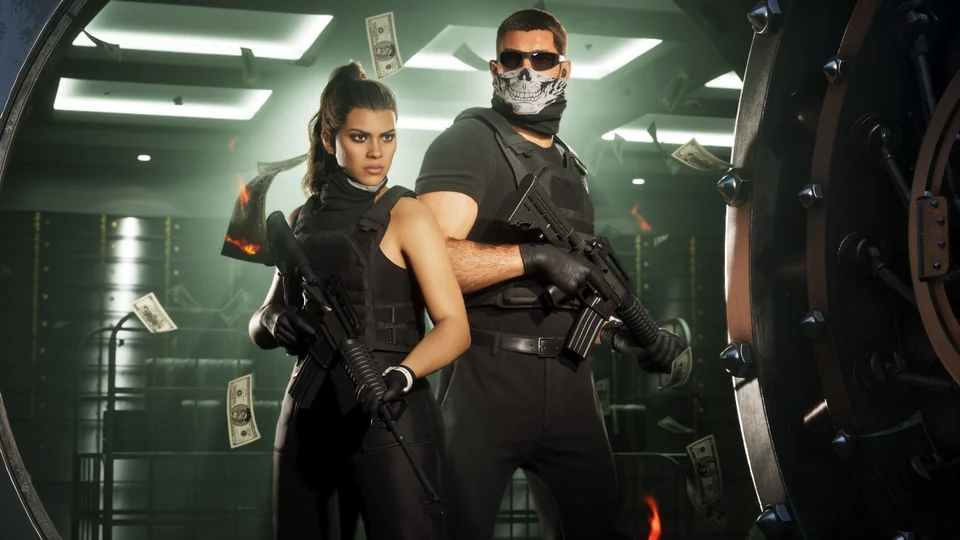
You can commit robberies between story missions in GTA 6, alone or with a partner. The targets named outright include shops, jewelry stores, small banks and criminal gang bases. You choose where to go and how to proceed, then account for people, security, the safe and an escape route inside. You still have to carry the loot away and, if you have stolen goods, sell them to a suitable fence.
The big change is how many decisions surround a single robbery. That comes through in Rockstar North development lead Rob Nelson’s interviews with IGN and Famitsu, and in the accounts of TGG, who watched the game at Rockstar’s studio. We examine those examples below. The developers have yet to publish a complete list of targets, payouts or rules for robbing a place again.
Which places can you rob, and how do you find targets?
According to Nelson in a conversation with TGG, you can try to rob any shop with an accessible interior. That is no promise that you can enter every building in Leonida, the game’s fictional state, or that every attempted robbery will succeed.
In his IGN interview, the developer names shops, banks and payday-loan outlets. On the way to one target, he changes his plan and goes after a car in a police impound lot that his partner mentioned. A pawn shop and a headphone store appear later in the demonstration. Sometimes an opportunity to make money turns up on the way to an entirely different objective.
There is more specific confirmation about banks. Nelson told Famitsu directly that jewelry stores and small banks can be robbed alone or as a pair. It is therefore no longer accurate to treat every bank robbery as a story mission. It would still be too early to promise free access to every enormous vault.
Tips can come from story acquaintances, people the protagonist has helped or chance encounters. TGG describes bigger targets whose approximate loot value may appear on the map. Small shops and gas stations need not have their own robbery marker. Looking for opportunities is part of the activity: checking the map alone will not uncover every job.
Gang bases broaden the choices further. They can contain cash and drugs, and the drugs can later be sold. A base is a different target in a different setting, so a shop, jewelry store, bank and gang base should not be treated as one mission with four signs on the door.
Why even a small shop can fight back
A clerk, guard or customer may intervene if they see a chance to stop the protagonist. TGG says he witnessed this several times. In one episode Nelson describes, Lucia struggles with a man for a gun in a jewelry store. Someone inside can derail the plan while your attention is elsewhere.
The premises matter too: where the safe sits, whether there is a back door, who is inside and whether cameras are installed. That gives you a reason to look around before drawing a weapon. A convenient exit at one shop does not make every other one safe.
Trouble can start outside. Nelson told Famitsu that a passerby may notice an armed protagonist preparing to storm a shop and call the police. Patrols could be waiting by the time you emerge. The time available to search for loot thus depends on more than your speed at the register.
Safe combinations, explosives and entering without an alarm
During the IGN demonstration, Nelson found a safe combination but noted that he could have used explosives. The blast would have damaged some of the contents. As he dealt with the loot, police gathered at the main entrance; a back door offered a way out.
The choice in that episode is clear: spend time preserving the contents, or open the safe faster and lose some valuables. The source gives neither a percentage loss nor a universal timer for the police response. There is no way to calculate one equally profitable option for every location in advance.
TGG adds that some safe codes can be found through your own search, learned in conversation or sent by a fence. In one shop shown to him, the search led to a back room covered in photographs of feet. The comic detail also says something about the world: information about loot can be tied to a particular owner and their premises. It does not promise the same clue in every back room.
There is a quiet option as well. In Famitsu’s example, Nelson discreetly opens a back door with a snap gun, a special in-game lock tool. Breaking the door down would have raised the alarm. Inside, he disables cameras and the security system, takes cash from the register and leaves undetected. The result depends on the whole situation: a concealed entry, surveillance and the alarm. Disabling one camera alone cannot guarantee that outcome in every robbery.
What changes when Jason or Lucia comes along?
In the IGN demonstration, the player controls Jason as he heads deeper into a shop toward the safe, while Lucia watches the entrance. They divide their attention: one looks for loot while the other keeps an eye on the people and the door. It is a specific example of partner behavior, not a complete list of commands.
The pair can help each other after leaving, too. Famitsu describes both arrangements in a chase: you can drive as Lucia while Jason shoots, or control Jason while Lucia drives. Shooting people directly is not necessarily required. Nelson describes suppressive fire near an opponent as a way to buy time to escape. How well that works depends on the encounter.
Working together also strengthens Jason and Lucia’s relationship. Romance, however, is not a condition of their criminal partnership. Nelson says they can continue helping each other even if the player does not develop them as a couple. A successful team robbery does not automatically mean you must build up the romance.
Repeated, unnecessary violence is tracked separately in the protagonist’s Criminal Profile and can change how the world responds. The robbery itself is not presented as the “wrong” way to play: Nelson distinguishes actions needed for a job from a habit of going further than necessary. Managing the couple’s relationship and deciding how much violence to use serve different purposes.
Your getaway vehicle must fit the loot
During the demonstration, Nelson admitted that he should have parked a vehicle near the business beforehand. A personal car has another use: it holds weapons and spare outfits. Preparation therefore covers what you will need after leaving, as well as what happens when the robbery starts.
Vehicle size matters for bags. In a separate breakdown, TGG says the protagonist can carry two duffel bags, with extra bags stored in a vehicle. A motorcycle provides no additional storage; you are limited to the bags carried on your person. A car can hold more, and a van or truck more still. Rockstar has not disclosed the exact capacity of each model. TGG’s example of a couple of bags in a car should not become a universal rule.
You have to consider both the escape route and the amount of loot when choosing transport: a bike will not carry extra bags.
After a robbery, the identifying details known to police matter: clothing, appearance, the vehicle and the fact that the criminals worked together. Changing one detail does not erase the others. We cover the wanted system separately. For a robbery, consider it when choosing an exit, outfit and vehicle, before police block the easiest route.

Stolen goods still have to become spendable money
TGG distinguishes three figures: your bank balance, the cash carried by the protagonist and the value of loot in a duffel bag. The value in that bag is not yet money you can spend. You have to sell the goods first.
Stolen items must be taken to a fence. These buyers specialize in different goods, including jewelry, drugs and cars in the examples given. You gain contacts as you progress. Planning a robbery therefore also depends on whom you can sell to afterward.
According to TGG, you can lose cash when you die, while money in a bank account is protected. An ATM lets you deposit cash. These are distinct actions: selling stolen jewelry and depositing money you already have solve different problems. The account does not establish that every kind of loot must go through one “money laundering” procedure.
How free-roam robberies connect to the story and Raul
Nelson says the story slows or pauses at certain points until the protagonists reach a required money goal. You will need to earn money between missions, but the sources do not prescribe a single method or require you to rob the same shop endlessly. Robberies are one way to prepare for the next part of GTA 6’s story.
Large scripted jobs remain part of the game. Rockstar introduces Raul Bautista as an experienced bank robber looking for people willing to take risks. His recklessness raises the stakes with every job. That profile explains his place in the crime story, but it does not yet reveal a crew recruitment menu, payout splits or the number of heists.

Nelson gives a specific example of a mission with Raul: first you control Jason as he fires back while Lucia drives, then control shifts to driving. You can stray from the suggested escape route and still get away. There is freedom within this designed sequence; it does not follow that every story mission can be planned entirely from scratch.
What remains unknown about robberies
There is no confirmed payout table, complete list of banks and vaults, schedule for cash replenishment or rule for repeat robberies yet. The detailed preparation rules for major story heists are also unknown: whether you can choose a crew as in GTA V, how the proceeds are divided and how many such jobs there will be.
TGG uses “tiers” to group robberies by scale. That is a useful way to explain what he saw, but Rockstar has not announced a final number of tiers. His estimates of the take from small shops and his description of vans as a separate category remain his assessments.
The most substantial detail shown so far lies between choosing a target and receiving the money. You must deal with the premises and the people inside, decide how much time to spend at the safe, choose transport for the loot and reach a buyer. A free-roam robbery is built from those connected decisions. A full walkthrough for a particular bank will require its own rules and verification in the game.
Sources
- Rob Nelson, full IGN interview, October 7, 2026. An accessible published copy of the interview was checked.
- Famitsu’s direct interview and demonstration, August 28, 2026: banks, a quiet robbery and the division of roles.
- TGG’s breakdown of robberies and the economy: targets, tips, codes, fences and the story’s money goals.
- TGG’s detailed breakdown of the demonstrated mechanics, bag discussion from 16:32.
- Rockstar Games’ Raul Bautista profile.