GTA 6 Car Inspirations: Which Real Cars Can You Recognize?
In breakdowns of GTA 6 cars, the Banshee is compared to the Dodge Viper, the Coquette to the Chevrolet Corvette, the Cheetah to the Ferrari Testarossa, the Comet to the Porsche 911, and the Dominator to the Ford Mustang. A single in-game car can combine features from several real models. Body shape, headlights, air intakes, and other distinctive details help identify its real-world inspiration. Carsales, for example, has compiled comparisons like these.
In-game names and real-world inspirations
A real-world inspiration is a car whose features can be recognized in an in-game vehicle. The game version retains a familiar silhouette but has its own name, badge, and styling details.
Rockstar’s website explicitly names the ’95 Grotti Cheetah, ’55 Vapid Stanier, and ’67 Vapid Dominator Buggy. The numbers are part of the names of these in-game variants. When identifying a real-world counterpart, it is important to consider the car’s model family, generation, and body style. A single generation, for example, can include both fixed-roof and convertible versions.
Relying on the fictional manufacturer alone can be misleading. Vapid is often associated with Ford, yet the GTABase vehicle guide links the Vapid Speedo van to the Chevrolet Express.
Sports cars and supercars
The Carsales breakdown makes the following comparisons:
| In-game name used in the breakdown | Real-world car or combination of influences |
|---|---|
| Bravado Banshee | Dodge Viper |
| Invetero Coquette D10 | Chevrolet Corvette C8 |
| ’95 Grotti Cheetah | Ferrari Testarossa family |
| Pfister Comet S2 Cabrio | Porsche 911 convertible from the 992 generation |
| Grotti Furia | Ferrari 488 Pista, SF90 Stradale, and Pininfarina Battista |
The Furia shows how a single car can draw on several sources of inspiration. The authors link its front end to the 488 Pista, its rear to the SF90, and its side profile to the Battista.
The Cheetah has a particularly distinctive profile. The first official image of the ’95 Grotti Cheetah shows a low, wedge-shaped body, wide side air intakes, and closed pop-up headlight covers. These headlights are concealed within the body when retracted.
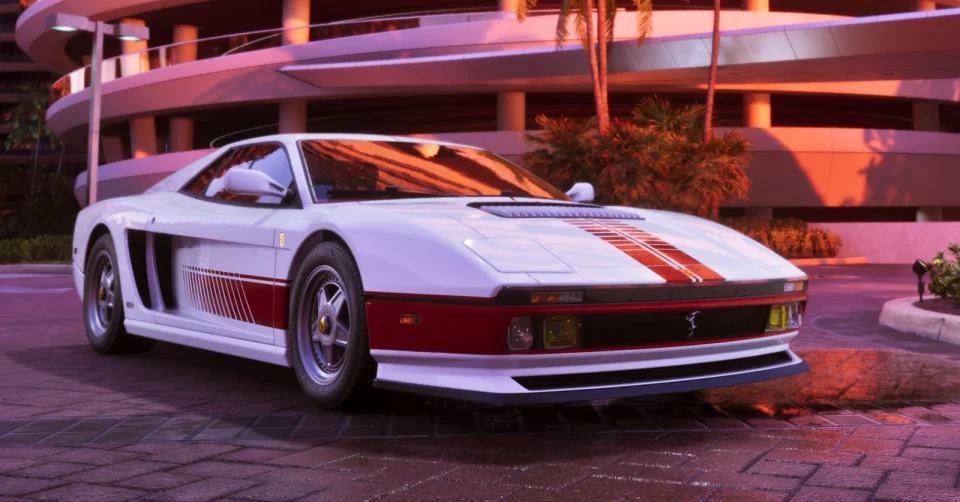
’95 Grotti Cheetah: wedge-shaped body, side air intakes, and pop-up headlights. Source: Rockstar Games.
GTABase compares the Progen Emerus to the McLaren Senna. In the October launch trailer, Car and Driver identifies Lamborghini Diablo and Bugatti Veyron influences. Meanwhile, in August’s An Extended Look showcase, in which Rockstar showed longer gameplay sequences, Jalopnik spots a Porsche Cayman lookalike in a nighttime street race.
Muscle cars, Japanese cars, and Jason’s Ganado
Muscle cars are powerful American-style cars with bold body designs. In this group, Carsales compares the Dominator to the Ford Mustang, the Buffalo to the Dodge Charger, and the Schyster Deviant to the 1972 AMC Javelin.
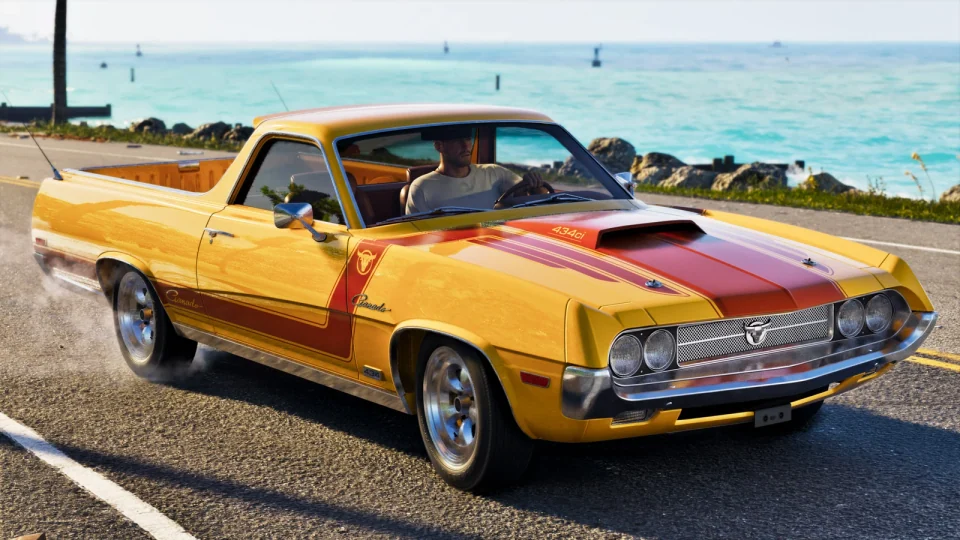
PC Gamer links the Tulip M-100 to the Chevrolet Malibu of the late 1970s and early 1980s. The same writer compares Jason’s Ganado to the 1970 Ford Ranchero. The Ganado combines a two-door passenger-car cabin with an open cargo bed.
Rockstar also shows a retro version of this vehicle called the Ganado Retro Build. The image clearly shows the Ganado name, a bull emblem, red stripes, and a protruding hood scoop. The paintwork and body kit noticeably change the impression made by the familiar body shape.
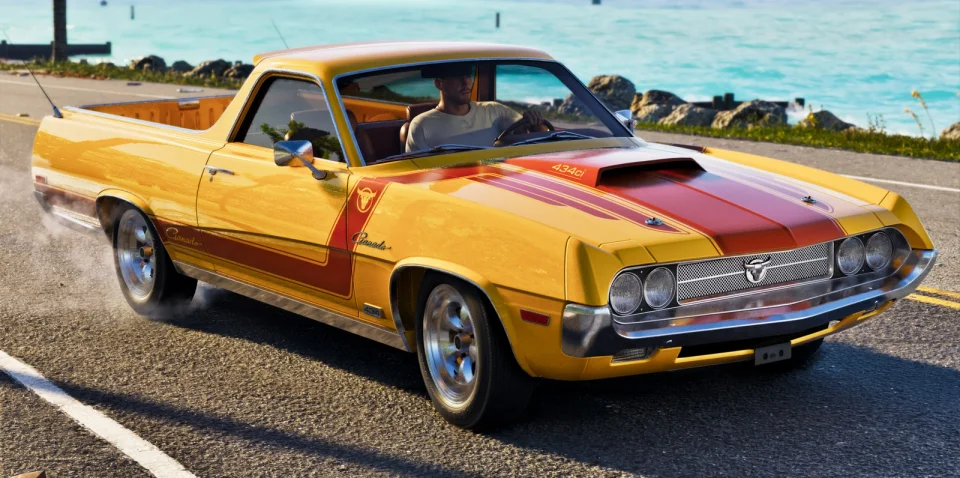
Retro Ganado build with stripes and a hood scoop. Source: Rockstar Games.
The Nissan Skyline provides a useful example of differences between generations. In the nighttime race from An Extended Look, Jalopnik points out a car resembling the R32. At the beginning of the October trailer, Car and Driver recognizes an R33 lookalike, with an iguana running past it. R32 and R33 refer to different Skyline generations, and the writers are describing different scenes.
Another example of blended design is the Maibatsu Penumbra FF in GTABase. The guide links it to the second-generation Mitsubishi Eclipse and Eagle Talon.
European cars in city traffic
An Extended Look also features more everyday European designs. Jalopnik’s Chris Tsui identifies the following cars:
| Car and scene in An Extended Look | The writer’s comparison |
|---|---|
| Convertible driven by Jason | BMW 3 Series E30 |
| Schafter sedan in the chase involving Lucia | Mercedes-Benz E-Class W212 |
| Schafter variant at the seaside car meet | Mercedes-Benz E-Class W213 |
| Coupe beside it at the same meet | A combination of the BMW 2 Series and 4 Series |
| Black SUV in the convoy leaving the airfield | Rolls-Royce Cullinan |
Carsales also compares the Übermacht Cypher to the F87-generation BMW M2 and the BMW M6.
Codes such as W212, W213, E30, and F87 help distinguish car generations. Body style matters too: Jalopnik calls the convertible a Sentinel and notes that a fixed-roof version already exists in GTA Online.
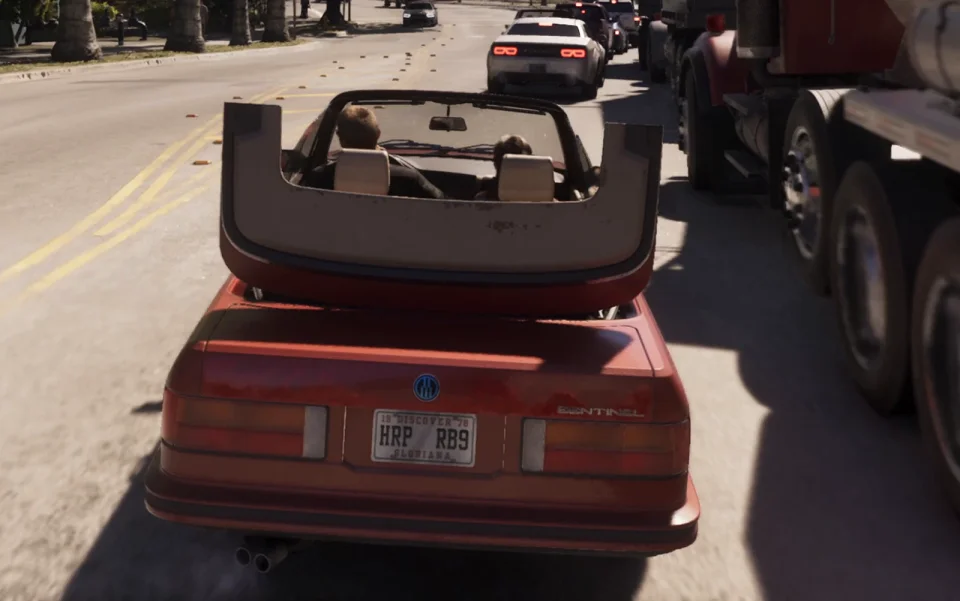
Sentinel convertible in An Extended Look, 08:31. Source: Rockstar Games.
SUVs, pickups, and vans
Carsales compares the Caracara 4x4 to the Ford F-150 Raptor, the heavy-duty Bison with dual rear wheels to the RAM 3500 HD, and the Yosemite 1500 to the Chevrolet Silverado. It also links the Mesa to the Jeep Wrangler. In the city traffic shown in An Extended Look, Jalopnik also recognizes a Range Rover-like design.
In the October trailer’s airport sequence, Car and Driver points out a pickup resembling the Ford Ranger. A character climbs from it onto an aircraft’s landing gear.
Additional entries in the GTABase guide offer two more comparisons: the Canis Terminus to the Wrangler JL, and the Übermacht Rebla GTS to the fourth-generation BMW X5. Jalopnik separately notes a car resembling the third-generation X5 in city traffic.
For vans, GTABase lists the following counterparts:
| In-game vehicle | Real-world inspiration according to GTABase |
|---|---|
| Bravado Youga Classic | Second-generation Ford Econoline |
| Vapid Speedo | Chevrolet Express with its 2003-onward design |
The Youga Classic returns from GTA Online, while the Speedo is familiar from GTA IV and GTA V.
Among electric cars, GTABase highlights the Coil Raiden, comparing it to the Tesla Model S.
Police cars and taxis
Official liveries help establish a vehicle’s role, while the body reveals its real-world inspiration. In the October trailer’s chase, Car and Driver identifies police SUVs resembling the Ford Explorer and sedans resembling the Taurus Interceptor. In sequences from An Extended Look, Jalopnik recognizes cars similar to the Dodge Charger.
Taxis come in several body styles. Jalopnik describes a yellow sedan resembling the Ford Crown Victoria, while GTABase compares the Granger Taxi to the Chevrolet Suburban.
The November selection also included a Pegassi Tempesta in police livery. Here, the combination of a sports car and police markings stands out.
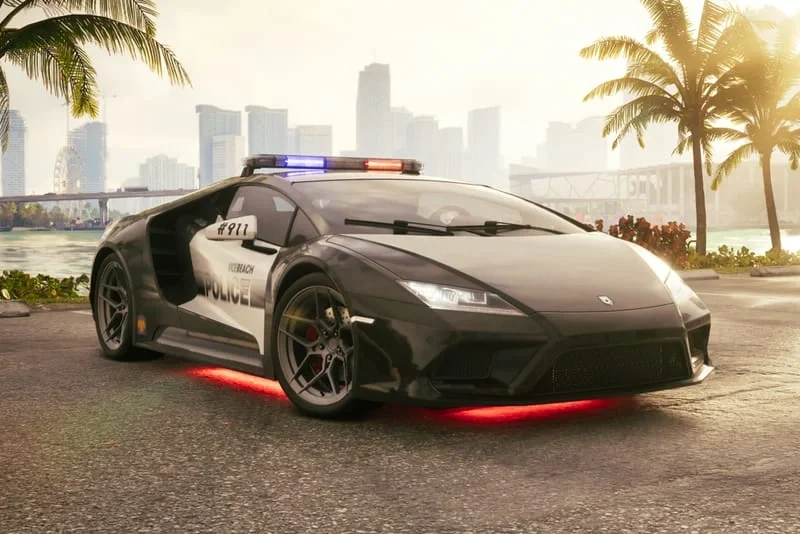
Pegassi Tempesta in police livery. Source: Rockstar Games, HypeDrive.
How to identify a car’s inspiration from a frame
A useful starting point is the car’s fixed features: the number of doors and the shapes of its roof, windows, wheel arches, headlights, and air intakes. Then look at the name and badge. Multiple angles help reveal details hidden in a single brief sequence.
It helps to compare paintwork, wheels, and body kits separately from the body itself. Large rims, a spoiler, or a new hood can substantially change a car’s appearance. PC Gamer, for example, notes a different hood on the Deviant and links it to possible customization options.
Sometimes a small detail is decisive. PC Gamer identifies the Gauntlet Hellfire by the distinctive recesses in its taillights, and the Cheetah Classic by its rear bodywork and the text on its license plate. The writer also distinguishes between the Cheetah Classic and the new ’95 Cheetah.
The source of the frame matters too. The first and second trailers, An Extended Look, and the launch trailer contain different scenes. A car’s front end may be visible in one sequence and its rear in another.
The silhouette helps explain the design. Power, speed, and handling depend on the vehicle’s underlying mechanics and settings within the game.
How GTA 6 cars became real
West Coast Customs built physical cars based on vehicles from GTA 6. HypeDrive showcased the Cheetah, Buccaneer, Emerus, Coquette, Manana, and Tempesta.
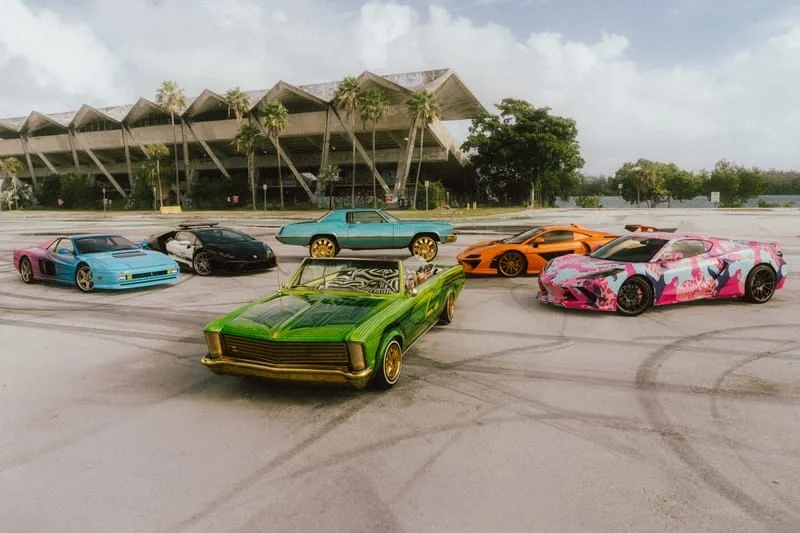
Cars from the West Coast Customs project. Source: Rockstar Games, HypeDrive.
Each build has its own paintwork, trim, and technical specifications. The Manana received raised suspension and huge donk-style wheels, while the Buccaneer has a lowered body in the lowrider style. These represent different strands of car culture.
It is an intriguing journey from reality into the game and back again: an in-game vehicle carries recognizable features of a production car, then builders modify a real car to match its in-game appearance. These roundups involve three distinct subjects of comparison: the factory model, the vehicle inside GTA 6, and the specific West Coast Customs build.
Sources
- Carsales: comparisons of in-game cars with production models
- Rockstar Games: official vehicle names and images
- GTABase: Vapid Speedo and Chevrolet Express
- GTABase: additional vehicle comparisons
- Car and Driver: cars in the October trailer
- Jalopnik: cars in An Extended Look
- PC Gamer: Ganado, returning cars and identifying details
- GTABase: Bravado Youga Classic and Ford Econoline
- GTABase: Coil Raiden and Tesla Model S
- RockstarINTEL: November images and police Tempesta
- HypeDrive: West Coast Customs project cars