Melee combat and stealth in GTA 6: punches, knives, grapples and quiet approaches
How melee combat and stealth work in GTA 6: Lucia and Jason’s styles, defense, knives, grapples, stamina, training and covert entry, with the evidence behind each claim.
Melee combat in GTA 6 includes punches and kicks, defensive moves, grapples and contact with the environment. In official footage, Lucia ducks an attack and strikes back, while Jason hits an opponent at a counter. Leaked footage shows Lucia throwing someone and, according to viewers, a wider range of knife-fighting moves for Jason. There are concrete examples of stealth too: crouching away from cover and entering a store without raising the alarm. Rockstar has yet to publish the full control scheme.
These details come from different kinds of evidence. Some actions appear in the official An Extended Look video. Others were described by invited guests at a presentation and by Rockstar North development lead Rob Nelson in a Famitsu interview. A third set is being discussed on the basis of footage from an unidentified test build. Here is what happens in those scenes and what we can reasonably infer from them.
Lucia and Jason fight differently
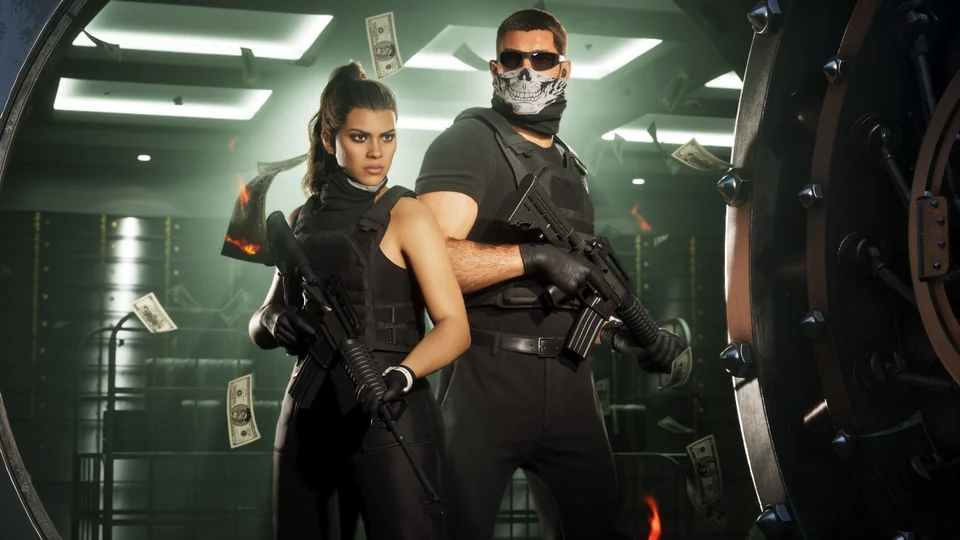
Lucia Caminos had fighting experience before the story begins: Rockstar’s official profile says her father taught her to fight from an early age. Jason Duval served in the military. Those backgrounds explain why both can defend themselves, but do not establish their in-game move sets.
Italian creator Federico Betti, known as MikeShowSha, described the difference in their styles after a private presentation at Rockstar North. According to his account, Lucia specializes in kickboxing and mixed martial arts, while Jason fights more roughly, like a street fighter with heavy hands. He watched a demonstration given by Nelson.
For players, the interesting possibility is that the two protagonists may feel different in close combat. Lucia ducking beneath an opponent’s arm and firing back in the official video gives a good sense of her movement. The clip cannot tell us her attack speed, though, and the description of Jason’s heavy hands does not mean each of his blows takes more health. Comparative stats are not available yet.
Dodging, a held block and parrying
An Extended Look includes a brief indoor scene with Lucia and several men. One man attacks; Lucia ducks under his arm and counters. It shows a sequence of defense and retaliation, beyond a simple exchange of hits.
TGG provided another detail in his analysis of the combat system. Relaying information from Kinda Funny, he says Nelson told them about a block that can be held and a parry that depends on timing. TGG adds that he did not ask about these mechanics in detail. The information about these controls therefore reaches us through TGG citing Kinda Funny; he does not describe testing the controls himself.
The distinction between the two defenses matters. Holding a block would protect the character while the player holds the relevant input. A parry calls for a response to a particular attack. The account does not reveal the timing window, whether a counterattack follows immediately, or whether either move protects against a knife.
We also cannot assign a separate button to every movement Lucia makes in the video. Parts of the sequence may depend on the fighters’ positions, their distance and an animation already in progress. A full controls demonstration or the released game should clarify this.
Grapples, throws and the environment
The most detailed street fight considered here appeared in the Stunt recording. After a dispute at an ATM, Lucia swings at a woman, who strikes back, and Lucia then moves into a grapple. The fight continues by a wall: Lucia holds the woman close, turns and throws her over her hip or back onto the floor.
The whole sequence matters. The opponents first face each other and trade attacks. Then they close the distance, a hold begins, their body positions change, and the scene ends with a throw that lifts the opponent’s feet off the ground. This contact differs from a hit that simply sends a character flying and falling.
The footage supports the presence of Lucia’s grapple and throw in the build shown. It does not confirm that players can freely choose any wrestling move, cancel one at any time, or drag a grappled target to another wall. There is no recording of the player’s inputs, and neither the build’s origin nor its age has been established precisely.
Can Jason grapple?
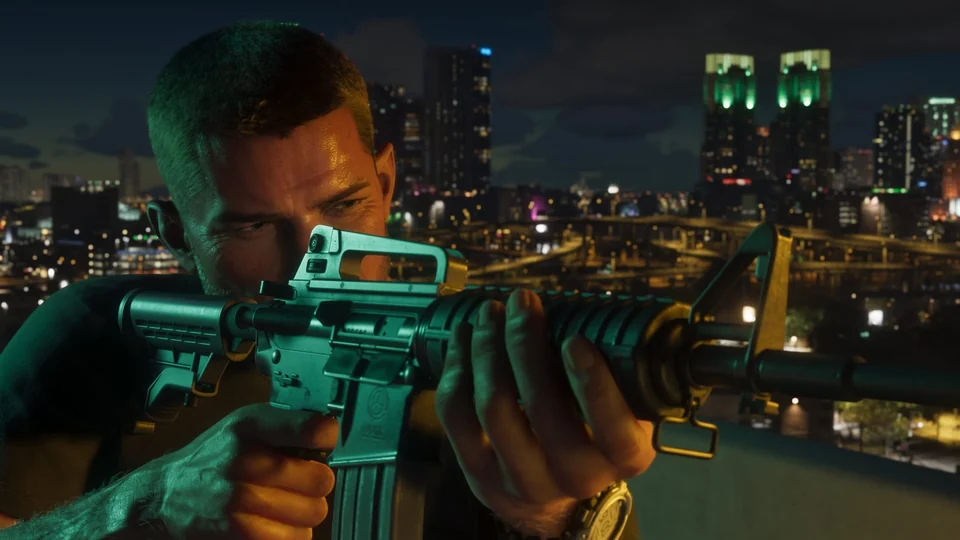
Lucia performs the clearest throw in that recording. Attributing it to Jason would be a mistake. His official An Extended Look scene is different: during a robbery, Jason strikes a man behind a counter, leaving him bent over its surface. It shows a close-range attack beside furniture, but does not explain whether the player chooses an interaction with the counter using a separate input.
This confirms Jason can fight at close quarters in a confined space. It does not show that both protagonists have identical grapples. Nor can we promise that players will be able to throw every passerby over any table or smash them against any wall. A demonstrated move and a universal rule for environmental interactions are different claims.
Official footage also shows a wrestling ring in a yard, where one participant lifts and throws another. The fighters cannot be reliably identified in that scene, so the ring is not evidence for a particular Jason move.
Jason, a delivery driver and a wrench
iGrandTheftAuto examined another street fight. In the second August clip, Jason’s car collides with a van and its driver gets out to confront him. Jason punches him, lands a jumping kick, then picks up the driver’s wrench after he falls and continues attacking.
The shift from fists to a nearby object is the significant part. Picking up the wrench after the opponent falls does not prove that a separate input lets the player snatch any weapon from anyone’s hands. We are considering the recording here through the publication’s analysis; the exact game version is unknown.
That report also mentions dialogue options labeled Warn and Defuse, meaning a warning and an attempt to calm the situation. Their outcomes have not been established, but the prompts raise another question alongside combat: can this particular confrontation be stopped before blows are exchanged?
How Jason uses a knife
Knife fighting drew substantial discussion after the fourth August clip. In the original Reddit analysis, poorna_sus14 listed three items they noticed: a standard knife, a switchblade and a hunting knife. They also pointed to the variety of combat movements and cuts on Jason’s arm after an encounter with an armed opponent.
These are a viewer’s observations of one leaked recording. They are useful because they describe more than the presence of a blade: Jason can visibly suffer damage during such an encounter. A cut on his character model does not, however, explain damage calculation, whether bleeding continues, or whether the injury restricts movement of his arm.
In the same discussion, the author compares the number of animations with Red Dead Redemption 2. An impression like that cannot become a precise finding without a comparable count. One clip also cannot establish how many strikes are required to win: the conditions, opponents’ health and test-build settings are unknown.
A separate theory concerns an icon in the knife slot. The post’s author linked it to police remembering a murder weapon. Other participants described a red circle with a handgun and suggested explanations ranging from police knowing a suspect is armed to wear on the knife. The icon alone cannot resolve these interpretations, so a system for identifying a specific knife remains speculative.
Knives and improvised objects are covered in our wider GTA 6 weapons guide. What matters here is how they are used: the attack shown, the opponent’s response and the consequences of the encounter, rather than a premature stats table for the entire arsenal.
Opponents do not have to wait for the next hit
In the ATM fight, the woman is not a passive target. She turns toward Lucia, attacks and keeps resisting until the grapple. The scene is therefore interesting for more than its striking throw: it shows a conflict in which the protagonist’s actions draw a response.
Viewers discussing the knife clip also noticed Greet and Taunt prompts. This observation connects street combat with conversation: an encounter may begin before the first punch. It does not mean the same line will always provoke the same reaction from every passerby.
In his Famitsu interview, Nelson explains that residents of the fictional state of Leonida may resist and may carry weapons. In his example, a car owner might open fire during an attempted theft. Residents also have a greater variety of heights and body types. None of this automatically means a larger opponent deals more damage.
Group fights are less clear. Several men being in the room with Lucia does not prove that they all attack at once or coordinate with one another. Target switching and companion behavior in such encounters have not been shown in detail.
What training changes in combat
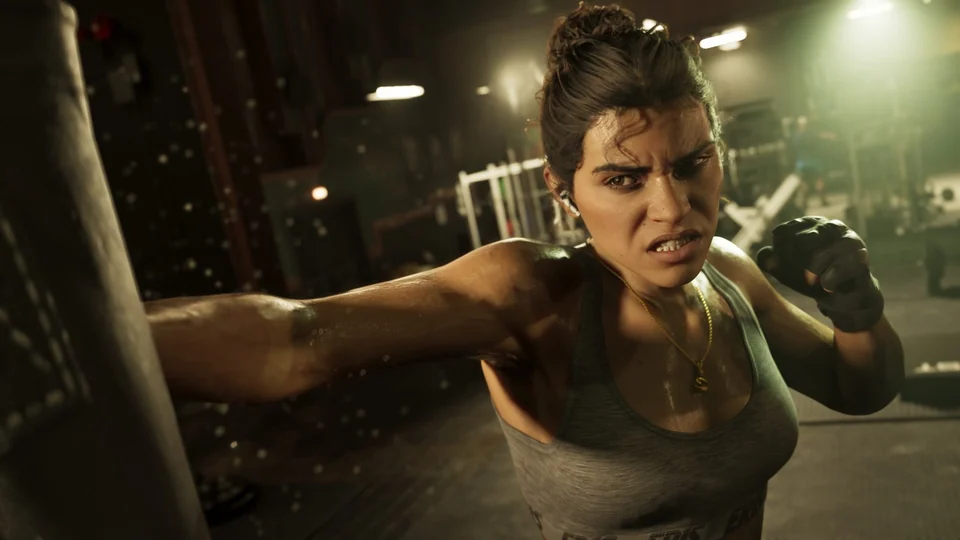
Official screenshots show Lucia at a heavy bag and in a gym. These scenes alone tell us nothing about which moves an instructor might teach. More substantial details again come from MikeShowSha’s account.

He says that, in the demonstration build, training for three consecutive days could increase strength by one point; the character’s physique changed along with the exercise. That condition then had to be maintained. He also described gym drinks and protein supplements that helped restore stats after exercise so training could continue. Each protagonist has their own stats.
The direct Famitsu interview adds detail about exercise: repetitions use stamina, a set must be completed before stamina runs out, and an excessive pace increases exertion. Nelson also confirms that training can raise base health and stamina. Food or drink can boost the meters temporarily as a separate effect. Character development therefore involves more than visible muscle.
There is an observation from combat itself. PC Gamer’s writers noted that what appeared to be a stamina meter fell as Jason punched in an August recording; after attacks with the wrench, it emptied and the screen edges darkened. They only speculated about a movement penalty. This suggests combat may consume a resource in that test build, but the precise consequences of exhaustion remain unknown.
Improving physical stats and learning a new throw are separate matters. There is still no verified list of fighting schools, requirements for learning combinations, or damage increase per strength point.
It is particularly easy to import memories of San Andreas into GTA 6 here. In that game, exercise and instruction had distinct functions: physical development changed stats, while defeating an instructor awarded a fighting technique. The relationship between those systems has not been fully explained for GTA 6. A heavy bag and a cage do not automatically confirm free access to every fighting style or a player-entered tournament.
Stealth begins with movement and observation
Stealth in GTA 6 is worth considering more broadly than a quiet strike from behind. The known examples concern the protagonist’s position, the point of entry and whether people or security notice what is happening.
TGG relays Nelson’s description of crouched movement that allows strafing. It works independently of snapping to cover; according to his account, cover is still activated with R1 on PlayStation. A character can move while crouched, including sideways, without pressing against a wall.
TGG did not see prone movement return. That is a limit of what he observed, not a direct Rockstar statement that all such movement has been removed. Older test footage showing a prone position cannot guarantee it will be available at release either.
Nelson gave Famitsu a concrete quiet-entry scenario: use a special tool at a back door instead of breaking in, disable cameras and the security system, then steal money without being detected. The result depends on the entire sequence, not one destroyed device.
This gives stealth a clear foundation: choose an entry point in advance, account for surveillance and avoid raising the alarm through a noisy action. We examine the broader set of approaches in our GTA 6 robberies article.
PC Gamer also noted a blue indicator in August footage that changed as police came closer to detecting Jason. This is an observation from one pursuit, not a complete model of how every guard’s awareness works.
Crouching alone does not promise invisibility. Rockstar has not published values for footstep audibility, lighting effects, detection distance or how long guards take to lose interest. If someone spots a fight, the question shifts to the police and wanted system.
Quiet takedowns, knockouts and moving bodies
A throw that leaves someone lying on the floor does not prove they died. The Stunt clip provides no reliable signal that distinguishes a knockout from a fatal outcome. It also does not show how long it would take for the woman to get back up.
TGG noticed that the screen edges turned yellow after Lucia incapacitated someone. He only speculates that a red glow follows a melee kill. One scene therefore does not provide a universal way to distinguish a knockout from death.
Actions involving a downed person are not limited to striking them. In its analysis of another August recording, PC Gamer describes a quick search: Jason bends over a body and takes items. That is a separate action from carrying or hiding a body. The same publication observed a stun gun used against security and a warning that repeated use of the healing item Zombix temporarily reduces its health effect. These scenes add ways to stop an opponent and recover, but do not reveal the duration of a stun or every possible outcome.
A stealthy robbery does not establish every familiar stealth-game action either. Promising a silent grapple, the ability to hide a body or a synchronized takedown with a companion would require footage of those specific actions. The sources considered here do not provide a complete answer. Confirmed cooperation between the protagonists during robberies does not imply that every such command exists.
Comparisons with GTA IV, RDR 2 and San Andreas
The most useful comparisons focus on specific actions. Each earlier Rockstar game offers a distinct point of reference.
| Game | What it helps explain about the new combat |
|---|---|
| GTA IV | Its official manual already distinguishes blocking or dodging, strikes, counters and kicks. The question is how the player times defense and retaliation, rather than simply how many strikes appear on screen |
| Red Dead Redemption 2 | Grapples, resistance and close-range struggles explain the interest in moving from strikes to holds. Similar body positions do not guarantee identical buttons or pacing |
| GTA: San Andreas | Muscle development and instructor sessions explain why strength gains and learning techniques need to be checked separately |
| GTA V | It remains a point of comparison for more varied contact moves. There is no numerical comparison yet of speed, damage or animation counts between the games |
In the Stunt fight discussion, some viewers welcome the resemblance to RDR 2 while others worry about a slow pace. That is an understandable difference in preferences. Reactions to a short video, however, cannot measure input delay or freedom of control. Those questions require hands-on testing, rather than a judgment based on how familiar a throw looks.
The movements and comparisons are also covered in our video on GTA 6 hand-to-hand combat, which is in Russian.
Practical questions still unanswered
There is now enough material to discuss the protagonists’ fighting styles, defense, knife encounters and quiet approaches. A full player guide still needs answers to several questions:
- The exact inputs for strikes, blocks, parries and grapples.
- The conditions for choosing and canceling a throw, and behavior near walls and furniture.
- Differences in damage, stamina and combat stats between the two protagonists.
- The rules of group fights and help from a companion.
- Nonlethal finishes, knockout duration and interactions with bodies.
- How new moves are learned, competition requirements and the rules of a future online mode.
Until those details emerge, examining specific scenes is the most useful approach: who acts, what the opponent does and which decision is actually visible. It lets us assess the development of melee combat and stealth without substituting expectations from earlier games for their actual mechanics.
Sources
- Rockstar Games: Lucia Caminos and Jason Duval, official biographies.
- Rockstar Games: An Extended Look, Lucia’s defensive move, close combat at a counter and the ring scene.
- Famitsu: interview with Rob Nelson, quiet entry, surveillance, residents’ resistance and NPC variety.
- MikeShowSha: account of the Rockstar North presentation, the protagonists’ styles and training, 10:16-11:17 and 15:42-17:20.
- TGG: combat mechanics and movement, crouching, cover, feedback and the report on blocking and parrying, 03:12-03:39 and 08:16-09:14.
- Stunt recording in a GTA6VC post, the ATM fight sequence. The original creator and build version are unknown.
- Original analysis of the fourth clip, poorna_sus14’s knife observations and other participants’ objections.
- Discussion of the ATM fight, views on pacing and the resemblance to RDR 2.
- iGrandTheftAuto: second August clip, the delivery-driver confrontation, wrench pickup and dialogue prompts.
- PC Gamer’s August 18 observations and August 19 analysis, apparent stamina, detection, searching, the stun gun and healing in leaked footage.
- The official GTA IV manual, controls section, and Rockstar’s San Andreas tips, the basis for comparing earlier systems.