New GTA 6 mechanics: what changes compared with GTA V
GTA 6 mechanics involving partners, weapons, car theft, police, loot, phones and workouts: what Rockstar has shown and how they compare with GTA V.
New mechanics in GTA 6 connect familiar activities more closely. A partner helps during drives and robberies, a weapon choice affects bystanders, a stolen car may reveal your location, and loot still has to be carried away and turned into money. Workouts and changes in physique return, while interactions with people and the phone’s functions expand. Some of these features appear in official footage; others are described by a developer and writers who saw a demonstration. The full rules of the release version are still unknown.
The main basis for this overview is Rockstar’s official presentation of August 27, 2026, and direct interviews with Rob Nelson, the head of development and one of the heads of Rockstar North. Famitsu, Flow Games and other invited writers spoke with him. They watched Nelson play, so their accounts of particular situations are more useful than a promise that any system will always behave the same way.
What features will GTA 6 have?
The most noticeable change concerns decisions before and after a familiar action. Before stealing a car, it helps to learn how it is protected. Before a robbery, you need to decide what to bring and how to leave. Afterwards, you need to consider which identifying details the police have and what to do with the contents of your bag. One episode can involve several systems at once.
The official An Extended Look contains extended gameplay scenes and a short montage of activities. Nelson’s explanations and the invited writers’ accounts help explain rules that cannot be seen from a single action.
Your partner takes part between missions too
Jason Duval and Lucia Caminos, the two GTA VI protagonists, can spend time together, meet up and go about their separate business. According to Nelson, while the player controls one of them, the other follows a routine of their own. Their life together continues outside mandatory missions.
The value of the partnership is especially clear on the road. Dazed and Flow Games describe switching between driver and passenger: one drives while the other can pull out a phone or fire at pursuers. This lets the player choose a role within a shared situation. An official chase with Raul Bautista also divides the work: Lucia drives while Jason shoots back.
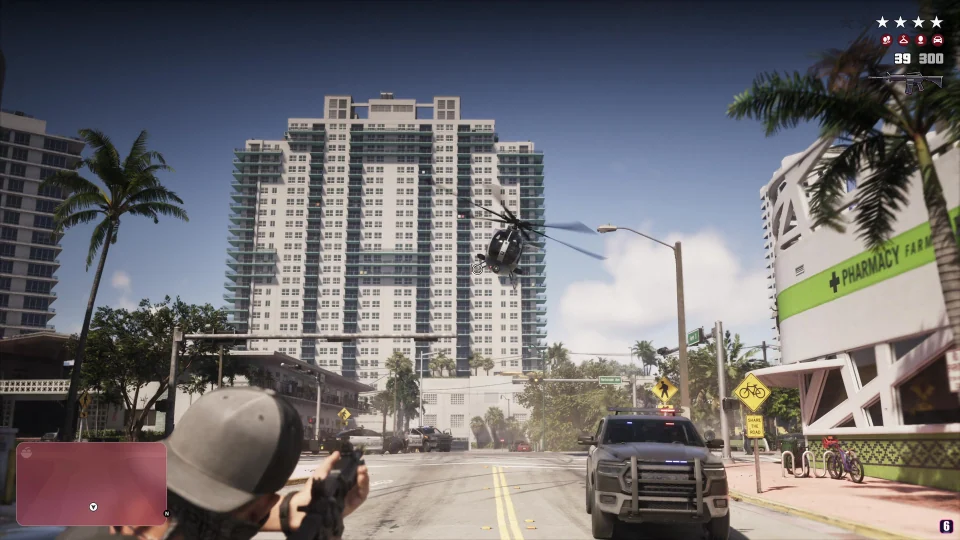
Free switching is limited by the staging of a particular mission. Nelson told Famitsu that some episodes are assigned to one character, while others switch according to the script. Two playable characters also do not imply two-player co-op: this is a single-player story with a game-controlled partner.
Romantic closeness develops through time spent together and how the two treat each other. The footage shows them holding hands, and the developer describes gestures available when their bond is close enough. The story also allows them to remain simply criminal partners. Skipping dates alone does not mean they will stop helping each other with story business. More detail appears in our look at Jason and Lucia’s relationship.
People notice how you behave
In an IGN interview excerpt available in a reprint, Nelson described how the interaction system has grown beyond Red Dead Redemption 2. You can call out to a passerby, get into an argument, or linger near a group and listen to its conversation. People may notice excessive attention or someone following them for too long. They might try to leave or become aggressive.
An argument shown to the journalist drew in another armed group. That is more informative than a broad promise of “smart NPCs”: a chance conflict may gain participants the player never targeted. Earlier GTA games also had armed pedestrians and hostile reactions. The difference Rockstar describes lies in the depth and context of those responses.
Another system, Criminal Profile, assesses the pattern of a person’s criminal behavior. Nelson distinguishes a criminal who acts with restraint from one who repeatedly commits unnecessary violence. The world responds accordingly. An active police chase and this profile serve different purposes: wanted stars relate to a pursuit, while the profile describes a broader pattern of conduct.
It would be wrong to import RDR 2’s Honor system directly. Nelson specifically rejected the familiar scheme of discounts for good behavior. He has not publicly set out every consequence or stage of the profile, so it is too early to calculate an optimal route from somebody else’s table.
Equipment changes preparation and combat
Flow Games’ writers describe a limited carried loadout: two handguns and two long guns. TGG’s detailed account adds that both long guns cannot be stowed on the back at once. One must be held. Spare weapons can be left in a car, and a gun can be passed to your partner.
That gives you a simple reason to prepare in advance. A rifle helps in a gunfight, but bystanders notice one carried openly. A gun on the back, held low, or aimed at a person also provokes different reactions. Storage limits and the known arsenal are covered in our GTA 6 weapons article.
Encounters themselves offer more ways to control a situation. Both protagonists have Focus, which Flow Games asked Nelson about, although their abilities differ. TGG describes slowed time and the highlighting of vulnerable parts of an opponent or vehicle. When looking for an escape route, Focus can also reveal police through obstacles. According to the same report, ordinary enemy markers have been removed from the minimap, aiming relies less on automatic target lock, and assistance settings can be changed. These accounts do not establish Focus’s duration, how its meter is spent, or the final differences between the characters’ abilities.
According to TGG, a yellow hit marker means a person has been incapacitated and a red one means they have been killed. During the demonstration, Nelson explained that an opponent who can no longer fight need not be finished off. This gives clear feedback to players who want to limit violence. The source does not promise that every mission can be completed this way.
TGG also notes that crouching is a movement state available outside cover. In the official presentation, Lucia fights at close range inside a jewelry store while Jason controls the entrance. It shows the partners handling different tasks in the same scene. A single episode cannot reveal a complete set of moves or the exact controls; our combat and stealth overview covers the topic separately.
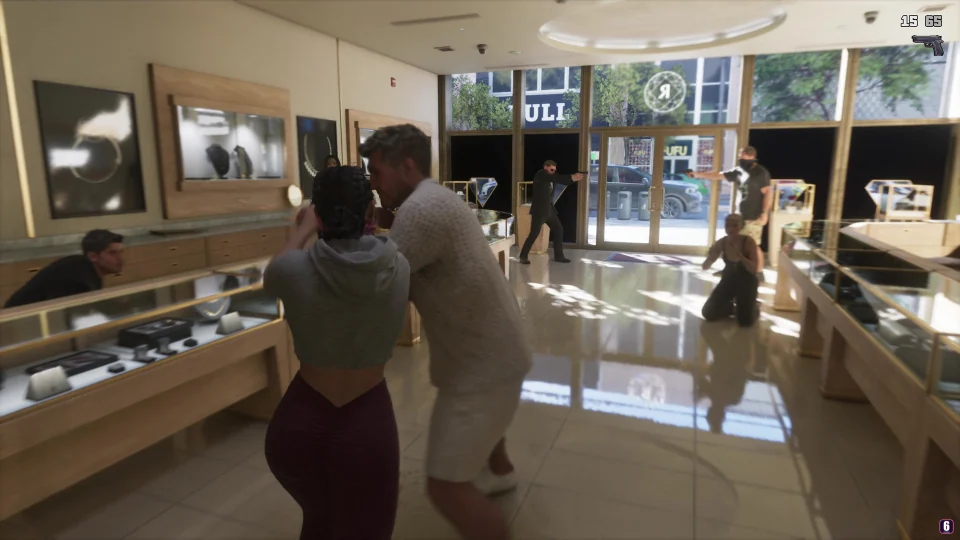
Famitsu describes another useful option: suppressive fire. Nelson explains that shots near an opponent may make them duck or hesitate, buying time to withdraw. A gunfight can therefore be about gaining a few seconds to escape. This does not amount to a promise that every mission can be completed without killing.
A vehicle has to fit the job
The protection on a parked car now matters. In his Famitsu interview, Nelson describes different tools, including a lock-picking device and an electronic key cloner. Tools and abilities become available gradually. Breaking a window and getting inside does not mean you can start an expensive vehicle.
A phone scanner helps before the attempt. According to the developer’s description and TGG’s account, it reports the car’s protection, tracker, value and conditions for registering ownership. Theft begins with an assessment: do your available tools suit the target, and can you sell it or keep it?
If registration is not available yet, the car does not necessarily have to be abandoned. TGG says a stolen vehicle can be stored in a purchased garage until the ability to register it opens up. Storage alone does not make it your personal vehicle. Famitsu also confirms that garages can be bought to expand a collection: progress and available spaces determine which cars can be kept in the long term.
A tracker links the theft to a later pursuit. Nelson gave the example of an expensive car that could disclose the driver’s position to police if driven slowly for long enough. This is a property of a particular protection class. It should not be applied to every car, nor should speed be treated as a universal way to hide.
The type of vehicle matters too. TGG says vehicles can carry different numbers of bags, so a motorcycle, a passenger car and a van offer different ways to move loot. His description of revised driving emphasizes differences between cars, narrower streets and heavier traffic. For now, this is an account of the demonstration, not our verdict after playing with a controller.
Fuel and charging appear in Flow Games’ own report and TGG’s account. Precision matters here: Flow says both that a car stops when its tank is empty and that the system is optional. The available report does not explain a switch for disabling it. Gas stations are described, but how often the game will require their use and what exactly can be configured remain open questions.
Escaping depends on what police know
In new descriptions of the wanted system, information about the crime matters: what a witness saw, whether an alarm went off, and whether the suspect’s face, clothing, weapon or vehicle is known. TGG presents Nelson’s aim as giving police a longer memory of events.
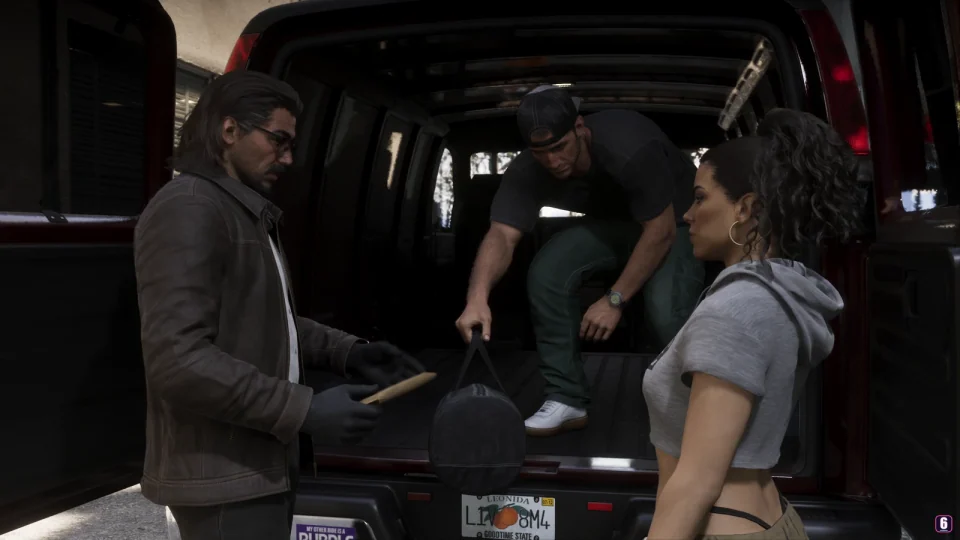
In the official presentation, the protagonists change vehicles after a car chase. Lucia prepares a Molotov cocktail beside the abandoned car, then the pair continue in a van. The sequence shows why an escape involves more than leaving one patrol’s line of sight. But this story example does not guarantee that setting any car on fire automatically erases every identifying detail.
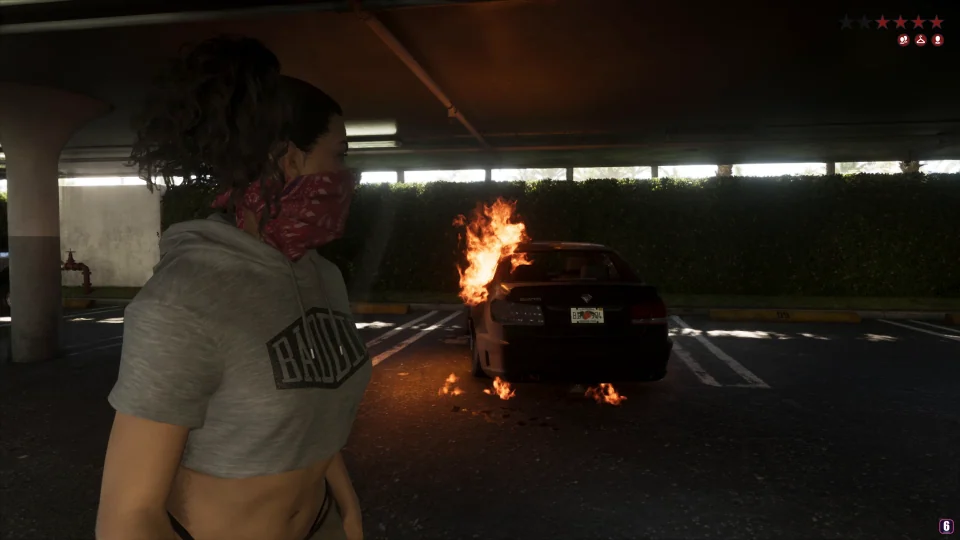
Driving away in a car unknown to police might help in one situation, while stepping out in the same clothing they saw might be risky in another. Hiding and disguising yourself make sense in light of the specific suspect description. Star colors, search areas and individual identifying details are examined in our GTA 6 wanted system article.
Loot still has to be carried away and secured
In the official store scene, Lucia keeps the room at gunpoint while Jason works at the register. The partner’s role is plain: one gathers the take while the other watches the people. More elaborate robberies add choices about the entrance and how to handle guards, cameras or a safe.
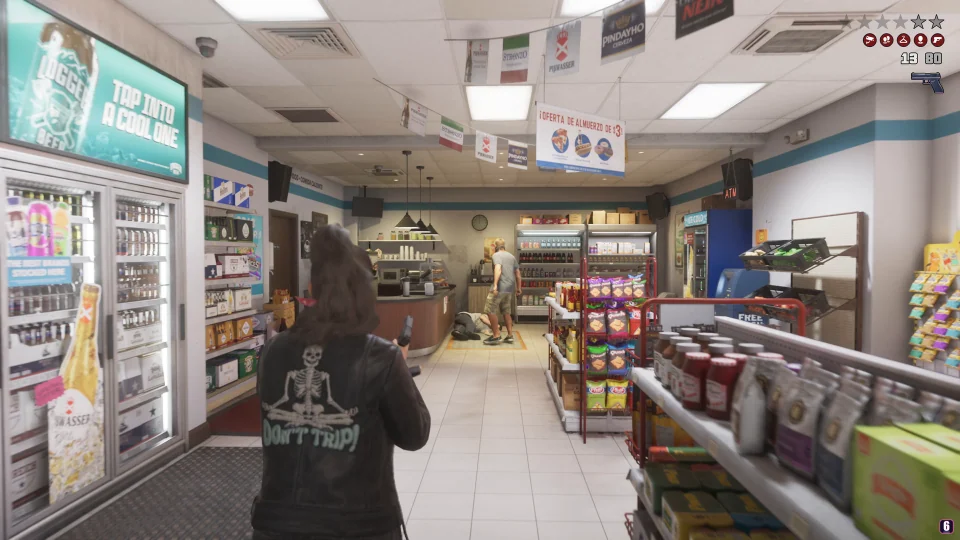
TGG’s firsthand account also includes a failed attempt. Nelson could not find the safe code, realized the police had already been called, and left without the loot. That outcome helps explain the mechanic: abandoning an objective may make sense when continuing increases the risk beyond the expected reward. Our GTA 6 robberies article covers preparation and escape routes in more detail.
The bank balance, cash in a pocket and contents of a bag have different roles. Flow Games explicitly reports that the protagonists share a bank balance. TGG distinguishes it from cash lost on death and loot that must be fenced. To deposit cash in a safe account, his report says, you have to reach an ATM: the banking app on the phone does not do it. The New York Times report offers a specific robbery involving marked bills meant for a fence. That is a condition of that job, not a rule for every banknote taken from a register.
This creates a linked series of decisions: what to take, how to transport it, whom to sell it to, and where to keep the proceeds. Nelson also told the invited writers that money earned outside main missions is needed to advance the story. Final amounts, limits and profitable routes remain unknown. The difference between loot, cash and the bank is explored in our guide to earning and spending money.
The phone helps you act in the world
Calls and apps already existed in GTA V. In the sixth game, the smartphone becomes a physical object held in the hand, and its functions are more closely connected to events around the characters. The demonstration describes scanning cars, calling a personal vehicle, using a banking app and exchanging messages between the protagonists.

Social media can point you toward a destination. TGG says that visiting the location of some residents’ posts lets you find an event happening in real time. The feed can therefore help you explore the world, though that does not mean every post works this way.
Dazed separately notes that a passenger can browse their phone while the other protagonist drives. The official video shows a stranger encounter too: Lucia finds someone in a trunk, followed by footage of his livestream.
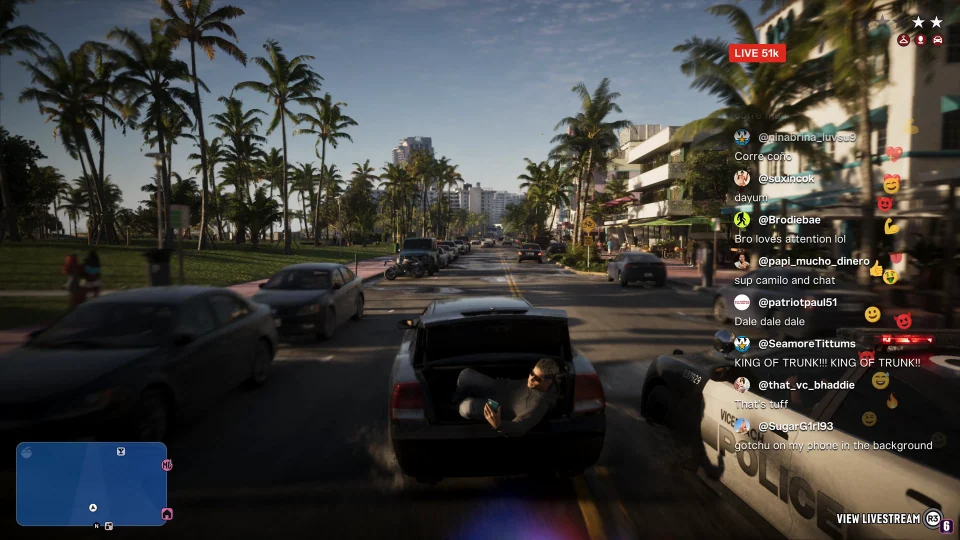
Nelson explained an important limit to Famitsu: the protagonists can read other people’s social feeds and send photos to their partner, but they do not publish their own public posts because they are in hiding. The livestream therefore gives no basis for promising a streamer career for Jason or Lucia. Known app names and functions are collected in our GTA 6 phone article.
Bodies and habits change with daily routines
Workouts affect the character and require player input. In official footage Lucia lies under a barbell, with L2 and R2 prompts on screen. The New York Times describes an exercise where the player has to maintain the rhythm of raising and lowering the weight; mistakes drain stamina faster. This is a distinct minigame, not simply a cutscene about visiting a gym.
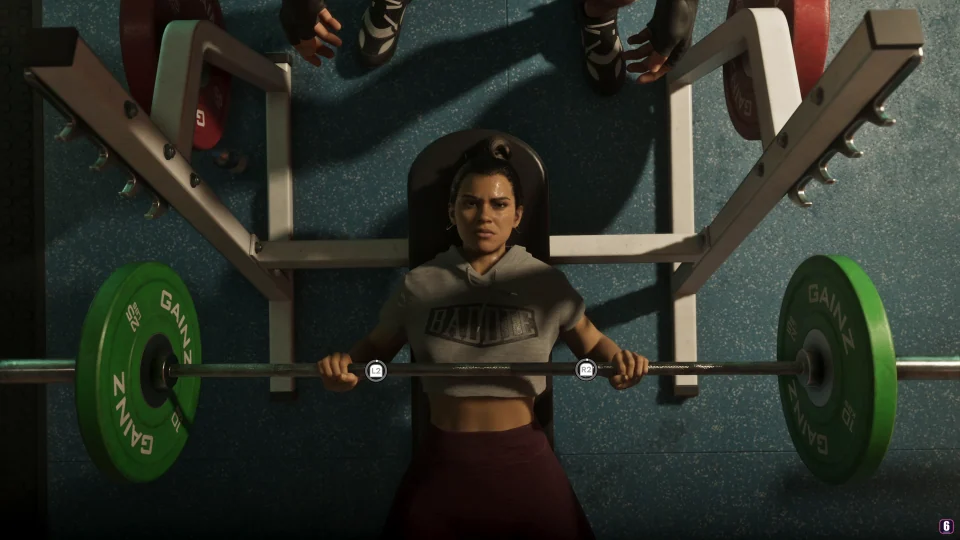
Dazed reports changes in weight and muscle from diet and exercise, as well as visible signs of long periods without enough sleep and of a hard lifestyle. Nelson explains that the development of base attributes and a temporary boost after food or drink work differently.
TGG explicitly reports that the game can be completed without going to the gym. The developers leave room for relaxed day-to-day play rather than requiring every playthrough to follow a workout schedule. Nelson says that even the shopping system, which allowed players to restock a refrigerator, was simplified for convenience.
Optional activities and encounters fill out daily life. The New York Times describes Jason petting a dog; the official montage shows basketball, diving, kayaking and racing. Here too, a possible interaction should be distinguished from a full sports mode. Nelson separately described a tennis court where you can pick up a racket and hit a ball, without a complete tennis minigame. More is covered in our guide to activities outside the story.
Outdoor activities serve different purposes. TGG relays Nelson’s description of catch-and-release fishing tied to relaxation, tasks and challenges. Hunting, by contrast, is described as a source of income through a character Jason knows.
Physics matters where it changes an action
The scenes show bags, weapons in hand, damaged cars and fire spreading across an abandoned vehicle. These details help explain specific actions. A character physically carries loot, and during a chase you can shoot at tires to disrupt a pursuer’s movement.
These scenes do not reveal the complete model for collisions and traction. Specific examples and limits appear in our GTA 6 physics and destruction overview.
How GTA 6 differs from GTA 5
GTA V already let players switch between protagonists. In the GTA VI footage, that familiar feature is tied to a shared drive: one person steers while the other fires or uses a phone. A particular mission may assign the roles.
The smartphone is familiar from the fifth game too, but in the described sixth game it helps assess a car’s security, find an event through another person’s post and communicate with a partner. The weapon wheel returns alongside a limited carried loadout, reserves in the car and the ability to pass a gun to the other protagonist. A familiar activity more often calls for preparation and a choice of role.
Not every feature here is appearing in the series for the first time. Eating, weight changes and workouts existed in San Andreas. Character switching, the phone and the weapon wheel were in GTA V. A returning feature is better judged by its new implementation than automatically counted as a GTA VI invention.
This comparison is primarily with GTA V’s single-player game. GTA Online and modded servers developed under their own rules and gained different sets of features over the years. The presence of the same activity does not by itself mean the underlying game systems are identical.
Until GTA VI is released, final settings, balance, prices, attribute thresholds and exceptions in individual missions remain open. What has been shown is enough to suggest a direction: a familiar robbery or drive increasingly asks players to consider several factors at once. Whether those factors work comfortably across a full playthrough can be judged after playing, rather than from a list of promises.
Sources
- Rockstar Games: An Extended Look, official presentation from August 27, 2026. This article examines specific gameplay scenes and interface elements.
- Famitsu: interview with Rob Nelson, covering relationships, character switching, world behavior, car theft, the wanted system and the phone.
- Flow Games: realism and game systems, based on Davy Jones’s visit to Rockstar North and a discussion of cars, weapons and everyday features.
- Flow Games: Jason and Lucia in gameplay, covering the shared account, Focus and changes of partner roles.
- The New York Times, reprinted by The Star: The grand ambitions of Grand Theft Auto VI, Christopher Byrd’s observations of the demonstration.
- TGG’s firsthand demonstration report, observations and reported remarks by Nelson. An eyewitness account is distinct from an official specification.
- Dazed: firsthand report and conversations with Rockstar, shared drives, everyday actions and physique.
- The available reprint of a read excerpt from the IGN interview, interactions with passersby and responses to a player’s attention.
- Rockstar Support: San Andreas tips and GTA V Story Mode weapon wheel, for historical comparisons.