GTA 6 budget: what is known about development costs
Where the $1-1.5 billion, $2 billion and $3.4 billion GTA 6 budget estimates came from, what Rockstar said, and why Take-Two reports do not reveal the game’s cost.
The exact budget of GTA 6 had not been publicly disclosed as of October 25, 2026. The billion-dollar figures circulating online come from analyst estimates, unverified reports and calculations based on company spending. They rest on different assumptions. None can be chosen as the established cost of the game.
There is more to the question than simply saying that Rockstar has given no figure. Jennifer Kolbe’s response in Bloomberg, the early reports behind the $2 billion rumor, and financial statements from Take-Two and Rockstar Games UK help show what has actually been counted and where speculation begins.
How much did GTA 6 cost to develop? What Rockstar said
In Bloomberg’s October 14 feature, Jennifer Kolbe rejected a rumor that the cost had exceeded $1.5 billion. Rockstar did not disclose an exact figure.
Kolbe oversees the company’s publishing operations. Her response concerned a popular comparison with Dubai’s Burj Khalifa, whose construction cost was put at $1.5 billion in that comparison. A headline claiming that Rockstar revealed the budget therefore promises more than she said. Her rebuttal does not establish an exact $1.5 billion cost, or a confirmed range starting at $1 billion.
Earlier, on May 5, Take-Two CEO Strauss Zelnick, whose company owns Rockstar, told Business Insider only that the game had been expensive. The numerical range next to his remarks came from industry analysts interviewed by the journalist.
Where the $1-1.5 billion, $2 billion and $3.4 billion figures came from
These figures are often placed side by side as though several people had read the same budget and reached slightly different totals. Their origins are actually different.
| Figure | Where it came from | What it establishes |
|---|---|---|
| $1-1.5 billion | Unnamed analysts interviewed by Business Insider, May 5, 2026 | An outside estimate exists, without a published breakdown of costs |
| More than $2 billion | Reports of alleged private messages following the Rockstar hack, September 2022 | Early circulation of a rumor, not the authenticity of a budget document |
| $2 billion | A forecast by investment firm Konvoy, May 9, 2025 | The amount used in its model of future payback |
| $3.4 billion | A calculation by GTA VI O’Clock’s Dan Dawkins described by PC Gamer in May 2026 | Another estimate incorporating preproduction and staff costs |
Why $2 billion became so persistent
On September 26, 2022, Dexerto reported on alleged private messages attributed to someone connected to the Rockstar hack. The person was said to have claimed that more than $2 billion had already been spent on the game. The publication also cautioned that it was unclear whether this meant money already spent or a final forecast, or whether marketing was included.
That distinction matters to the history of the figure. It appeared in news coverage alongside a genuine leak of game footage, but the authenticity of the videos does not verify the monetary claim. That claim needs its own document or a verifiable account of its source.
The same $2 billion figure appeared in a Konvoy newsletter in 2025. The firm placed it among its own forecasts and predicted payback in less than 30 days after release. The newsletter does not publish a calculation of actual production spending. A financial firm’s later use of a familiar figure does not establish that the earlier rumor was correct.
PC Gamer links Dawkins’s $3.4 billion estimate to preproduction and six years of Rockstar staff costs. It illustrates a different way to approximate the scale of investment. Without allocating company spending between projects, however, such a calculation cannot become a GTA 6 budget.
Why Take-Two’s reports do not reveal the cost of GTA 6
The reports do contain billions of dollars related to game creation. But Take-Two includes Rockstar, 2K and Zynga, and the relevant lines cover the publisher’s portfolio. The company records some costs it has already incurred as part of games under development and recognizes them as expenses later. This is known as capitalization.
As of March 31, 2026, the annual report listed $2,149.7 million in such development and license costs for games that had not yet been released, excluding the current portion. That line gives no breakdown by title.
In the quarterly report as of June 30, the total non-current portion of development and license costs was $2,395 million. This is a broader category: it is not limited to unreleased games. Here, “current” and “non-current” describe portions of an accounting asset, not recent and older spending. Subtracting those figures does not yield an increase in GTA 6’s budget.

Note 7 of Take-Two’s quarterly report. Amounts are in millions of dollars and cover the publisher’s portfolio. Open the excerpt to see it at full size.
Take-Two may also charge early costs directly to research and development instead of including them in the value of a game under development. The balance sheet amount therefore does not capture every cost of a game over its lifetime or set a ceiling on future spending.
What the Rockstar Games UK accounts show
The UK’s Companies House registry provides a more specific example. For the year ended March 31, 2025, Rockstar Games UK Limited reported £363.099 million in staff costs. Of that, £282.672 million was wages and salaries; the rest included social security, pensions and share-based payments.
The same note reports an average workforce of 1,744 people: 1,625 in development and 119 in administration. These are figures for one legal entity and one year. They do not describe all of Rockstar’s international operations or divide employees’ work between GTA 6, support for released games and other tasks.
Even a carefully added total of salaries over several years would leave two gaps: how much belonged specifically to GTA 6, and which costs were absent from the chosen lines. Multiplying today’s team size by an assumed salary and a number of years adds further assumptions, since staffing and workloads changed. The company’s structure is covered separately in our article on the GTA 6 developers.
What a game like this costs money to make
Production spending extends beyond programmers’ salaries. Take-Two’s accounting policy mentions employee labor, compensation tied to the completion and release of projects, external development, production and content creation. The UK accounts also show that staff costs extend beyond wages alone.
There is a concrete example of investment specifically in GTA 6. In his video account, Jason Schreier said Rockstar established a separate studio in Los Angeles to work on non-player characters and hired writers, directors and producers. Filling the world with NPCs required additional people and production capacity. The cost of that work, and its share of the game’s budget, has not been disclosed.
The detailed development timeline helps explain the scale of the work. But neither its length nor an impressive image tells us how many dollars went into a particular part of the world. There is no published breakdown here for graphics, writing, actors, music, testing or individual mechanics.
A good example of misleading precision is the claim of $200-300 million for water physics. In August 2025, Dexerto distinguished that monetary estimate from the account gamernewsonx from an earlier Rockstar Magazine report about the technology. The older report about water does not support the price tag added later. Verified information about GTA 6 physics is not a financial budget either.
Does the budget include marketing?
Without an explanation from the author of a particular estimate, we do not know. Game production, promotion around launch and subsequent support may be counted separately. Money pledged for years ahead is also different from costs already incurred.
Another figure appeared in October: “at least $150 million for marketing.” Its source is identifiable. In an October 9 report by The Miamian, Miami-Dade County Commissioner René Garcia said he had done his own research and arrived at that amount. The article presents neither his method nor a Rockstar document.
This is therefore an official’s estimate in a dispute over an advertising agreement, not a company-announced total marketing budget. It cannot automatically be added to $1-1.5 billion: we do not know what costs the analysts already included. The value of a single advertising contract also does not disclose the cost of the whole campaign. Our report on the Vice Beach promotion in Miami Beach covers one specific agreement.
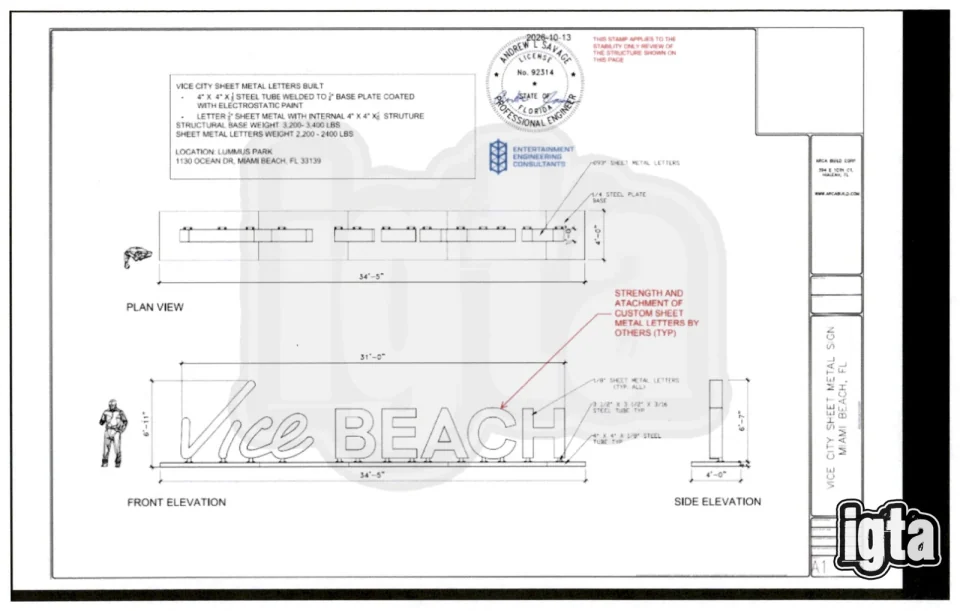
Proposed Vice Beach sign in the October 15 agreement published by iGrandTheftAuto. Open the plan to view it at full size.
Is GTA 6 the most expensive game ever?
It may be among the most expensive, but the available figures cannot produce a verified ranking. A meaningful comparison needs matching cost categories and periods, with clear origins for both figures.
An often cited comparison with GTA 5 uses a historical press estimate of about £170 million for development and marketing combined, published in 2013. Third-party estimates are also often used for RDR 2. Dividing an unverified GTA 6 budget by those figures to claim a precise multiple is premature.
There is an example of more transparent disclosure. CD PROJEKT put Cyberpunk 2077’s total budget at about 1.2 billion zlotys. In its 2020 results presentation, the company explained that 55% covered direct development and allocated overheads, with the rest going to marketing and communications by the company and its physical distribution partners. That defines what the total included at a particular stage. Later improvements and expansions cannot silently be treated as already included.
Star Citizen raises another kind of confusion. In June 2026, Cloud Imperium reported $1 billion in community funding for Star Citizen and Squadron 42. Money raised is not the cost of making a single game. A separate CIG financial publication distinguishes income, expenses and capital investment. Comparing a funding counter with GTA 6’s supposed production cost as if they were equivalent budgets is misleading.
What would it be in rubles, and when might the game pay for itself?
There is no reliable GTA 6 budget in rubles either, because the exact starting figure is unknown. A particular estimate can be converted if the assumption is made explicit. For example, at a hypothetical exchange rate of 100 rubles to the dollar, $1 billion would be 100 billion rubles and $1.5 billion would be 150 billion rubles. This is an arithmetic illustration, not the current exchange rate or a new estimate of Rockstar’s spending.
Costs incurred over many years also arose in different currencies and on different dates. Converting a final dollar estimate at a single current rate offers only a sense of scale.
There is no confirmed payback period for GTA 6. The less-than-30-day period mentioned above is Konvoy’s forecast based on its assumed $2 billion investment. It is not a calculation using a disclosed budget and actual sales.
Dividing a budget by the retail price of a copy does not reveal the required number of sales either: the full amount paid by a customer does not become publisher revenue. Taxes, sales terms, platform fees and other expenses matter. Projected future revenue does not establish profit already earned.
A large budget indicates the size of the financial risk, but it does not by itself determine the price of a copy or guarantee quality. A credible new claim about costs should answer at least three questions: who supplied the figure, what period it covers and what it includes. Until those conditions are met, GTA 6’s exact production cost remains unknown.
Sources
- Bloomberg Businessweek, October 14, 2026: Jennifer Kolbe’s response to the $1.5 billion rumor.
- Business Insider, May 5, 2026: Zelnick interview and separate analyst estimate.
- Dexerto, September 26, 2022: early report on alleged messages and $2 billion.
- Konvoy, May 9, 2025: the firm’s own forecast using a $2 billion investment.
- PC Gamer, May 8, 2026: account of Dan Dawkins’s estimate.
- Jason Schreier, video account of GTA VI’s development: new studio for NPC production, 10:05-10:16.
- Take-Two 2026 annual report: accounting policy and costs of unreleased games.
- Take-Two quarterly report as of June 30, 2026: Note 7 on development and licenses.
- Companies House, Rockstar Games UK Limited: accounts for the year ended March 31, 2025, pages 3 and 29.
- Dexerto, August 27, 2025: origin of the water-physics price claim.
- The Miamian, October 9, 2026: Garcia’s statement about advertising spending.
- CD PROJEKT, 2020 results: composition of the Cyberpunk 2077 budget, PDF page 2, discussion of slide 7.
- Cloud Imperium, June 2, 2026 and the CFO’s explanation: funding and separate accounting for spending.
- The Guardian, September 17, 2013: historical GTA 5 production and marketing estimate.
- iGrandTheftAuto, Miami Beach agreement: source of the Vice Beach plan.
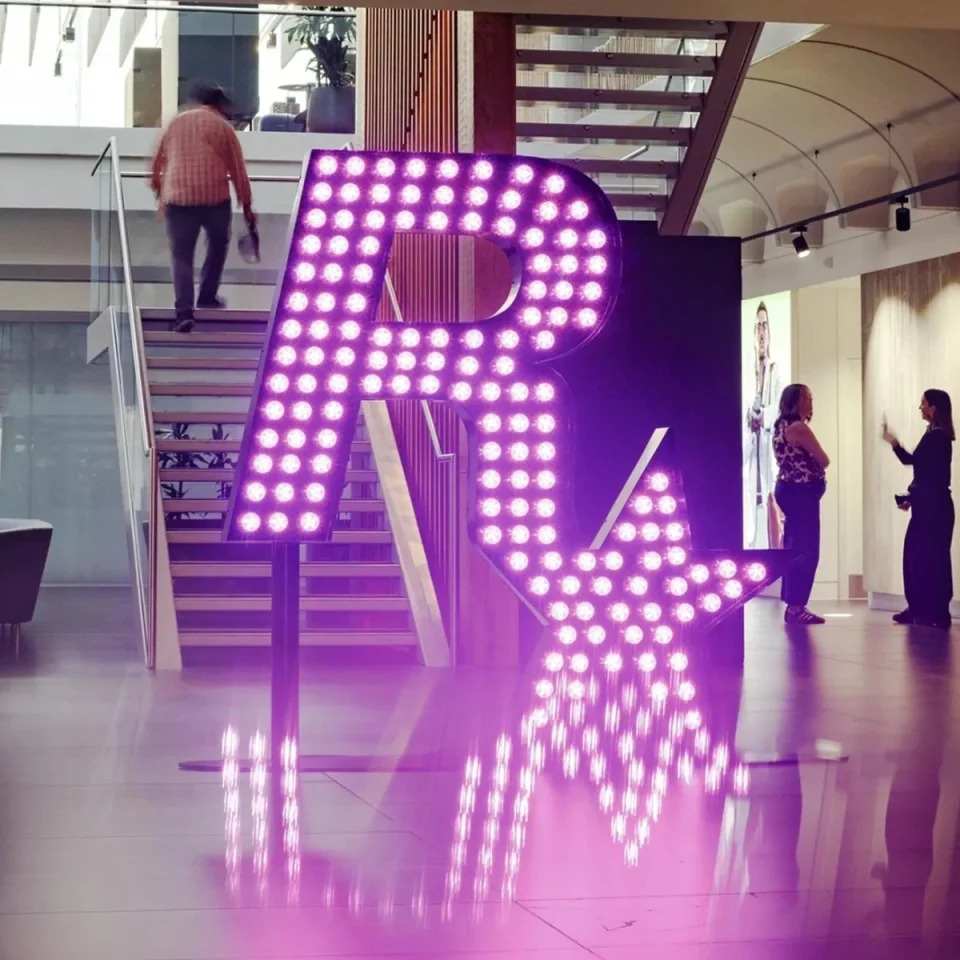
Cover studio photograph: Robert Ormerod for Bloomberg Businessweek, published October 14, 2026.